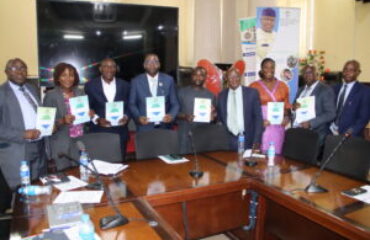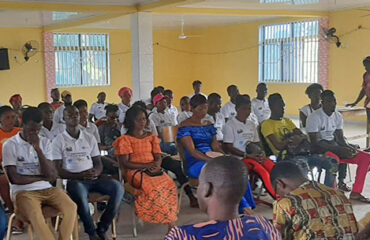
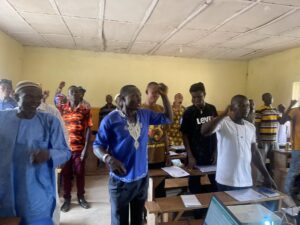
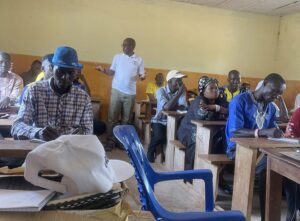
Over 40 participants in the Karene District have benefited from a two-day workshop organized by the National Council for Civic Education and Democracy (NaCCED), with support from Sightsavers Sierra Leone. Speaking at the workshop, Eric Musa, Programme Manager at SightSavers Sierra Leone, said the social inclusion programme aims to improve teaching and learning methods, especially for children with disabilities in schools.
In his presentation, Musa emphasized that even though there are many aspects to consider as children acquire formal education, the need to safeguard them throughout their learning process is key. He went on to say the Code of Conduct, as prescribed by the Teaching Service Commission, is what teachers should go by.
“Teachers are role models in society, and they should protect every gender in and out of the classroom, and not use their powers to intimidate, harass, or exploit girls or women, which is part of civic engagement.”
On the aspect of changing the narrative and stigmatization of children living with disabilities, he encouraged the teachers to be more open and accommodating while dealing with children who are physically challenged.
He highlighted the need for teachers to support children in not just joining the civic school clubs but also participating and taking up roles to build their confidence.
Vincent Kamara, Deputy Head Teacher at R.C Rokulan, on the subject of the punctuality of pupils, said, “Excessive domestic chores given to some of the children at home affect their capacity to perform well when they finally get to school.
Kamara said that with the civic school clubs, the pupils have taken the responsibility to learn about their rights and responsibilities, whilst balancing it with their studies.
Alphan Tajawie, Director of Curriculum Development and Training at NaCCED, in his session, discussed the concept of leadership and how teachers can effectively use it to guide and influence their pupils.
He said that the teacher-student relationship is one that should be built on mutual trust and respect, while, as teachers, the ability to make decisions under pressure is vital in taking up leadership.
In his presentation, he called on teachers and community members to exhibit trustworthy tendencies and empower others to grow.
Abdulai Turay, Assistant Director, Ministry of Social Welfare, Karene District, spoke on Gender Based Violence and the Sexual and Gender Offences Act that criminalizes certain actions as the law sees fit, with the penalties that come with going against laws.
He went on to say that, as social workers would be deployed at various schools to monitor the attendance list of teachers as well as students, teachers must ensure they get to mark the attendance and monitor the participation of pupils in schools to deter school absenteeism.
Participant Fatmata Kargbo said, “Harassment is not as prevalent as it was, as reporting is now common and perpetrators now face the law.”
Turay’s lecture captured the aspect of what constitutes rape and sexual penetration and how teachers and community members should desist from such a heinous act.
Hindolo John-Langba, Monitoring and Evaluation Officer at NaCCED, gave the final presentation on the levels of participation for the benefit of community members in society.
The umbrella body of this scheme comes from the Citizen Participation Project that seeks to provide young women and men living with disabilities the choice of political participation and civic engagement.