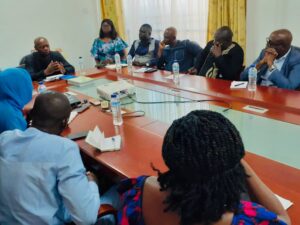
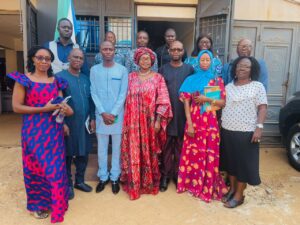
National Council for Civic Education and Democracy (NaCCED) on Thursday 2nd February, 2023 hosted a seven-member delegation from The Gambian Parliamentary Caucus on Freedom of Religion or Belief (FORB). This courtesy call is part of a 2-day exchange program visit to Sierra Leone, funded by the Foreign and Commonwealth Development Office and Freedom of Religion or Belief Leadership Network (FoRBLN) in the UK, in partnership with the African Centre for Parliamentary Affairs (ACEPA) based in Accra, Ghana.
According to the Governance Advisor from ACEPA, Mr. Issifu Lampo, the project aims to ensure that Parliamentarians in Sierra Leone and the Gambia are able to promote and protect freedom of religion and belief, as well as to serve as a model for West Africa. The delegation’s visit to National Council for Civic Education and Democracy (NaCCED) is to enable them interact with members of the institution, share ideas and experiences on civic engagements and outreach programs, especially its working relationship with Members of Parliament of Sierra Leone and the ordinary citizens. “This is an exchange visit to share knowledge and perspectives as per what pertains in the Gambia and what obtain in Sierra Leone when it comes to freedom of religion and belief,” said the head of the Gambian parliamentary representative. He informed NaCCED staff and the journalists present that, Members of Parliament of the Sierra Leone Parliament had also been to the Gambia to meet with different institutions as part of the exchange program.
The Chairman for NaCCED, Mr. Kalilu Totangi, in his welcome remark expressed pleasure in hosting the Members of Parliament from a sister country, and hopes that both countries could learn from each other’s wealth of experiences and mutually benefit from the initiative. Mr. Totangi informed the delegation that the Council came into being in 2018 with the aim to not only educate citizens on their civic rights and responsibilities, but also engage them on governance processes, their roles in promoting national development as well as promoting peaceful co-existence. “The ultimate aim is for us to have a disposition of tolerance, civility in dealing with one another as citizens,” he said. The Chairman told the Gambian delegation that NaCCED has been able to make tremendous national impact over the years through “knowledge sharing and promotion of skills and aptitude development.”
The Chairman also informed the delegates that the Council which now exists as a legal entity – an Act of Parliament, had produced seven (7) civic education textbooks for primary and junior secondary school levels in the country, and as a stand-alone subject. He informed them that the move is part of the president’s vision to revive Civic Education in schools which was previously part of the country’s school’s curriculum in the 80’s to 90’s.
On religious and tribal tolerance, the Chairman stated the Sierra Leone is internationally recognized for her religious tolerance which he said “has been evident in the records of peaceful co-existence along the line of religion.” He then added that tribal difference has never posed a threat to national peace and cohesion, until the wave of politics kicks in during elections. “Tribe is never an issue for our country because we marry and settle across tribal lines, except when some of our political leaders want to claim undue advantage so they go to the under belly and talk about tribe.” He added that the Council, with support from partners, has been educating citizens about the downsides of tribalism and ethnicity in national politics through messages and outreach programmes.
The meeting then transitioned into a question and answer session where the Gambian FORB caucus MPs inquired on various issues bordering on NaCCED’s functions. Questions covered a range of concerns including the relationship between NaCCED and politicians and how much NaCCED has done to improve citizens’ understanding of the roles of MPs; the approach to minority groups and their rights; whether there is a religious council in the country and NaCCED’s relationship with the council; what is the approach to dealing with hate speech; and education on Female Genital Mutilation (FGM) in communities.
The NaCCED Chairman provided succinct responses to all the questions, and xplained in detail how NaCCED mandate and work cover all the concerns raised. He established the institution’s commitment to do more in national developmental.
Honorable Lamin J. Sanneh, described civic education institutions as very important, stating that there are striking similarities between Sierra Leone and the Gambia. He inquired about NaCCED role in dealing with minority groups, and ways they have been engaged on the roles of Members of Parliament.
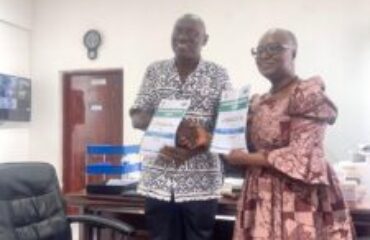
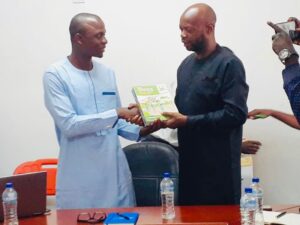
The visit was crowned by a presentation of the seven (7) civic education textbooks for Primary and Junior Secondary School levels to the Gambian delegation by NaCCED’s Chairman.