 The National Council for Civic Education and Democracy (NaCCED) successfully anchored Sierra Leone’s 2026 Open Gov Week celebrations, signaling a powerful shift away from passive data sharing toward active, citizen-led governance. At the forefront of this national milestone was NaCCED Chairman and Open Government Partnership (OGP) Focal Person, Mr. Joseph Munda Bindi, who convened a high-profile roundtable expert panel discussion at the Foreign Service Academy. Guided by the global theme, “A Global Call to transform the way Governments serve their Citizens,” Bindi strategically positioned NaCCED as the primary bridge linking state machinery with civil society, steering a critical dialogue on how to move beyond paper commitments and permanently embed openness into daily public service delivery.
Reflecting on over ten years of OGP history in Sierra Leone, Bindi highlighted how this United Nations-rooted initiative has radically reshaped the country’s governance structures by giving ordinary citizens the leverage to shape the national development agenda. He noted that the true value of Open Gov Week lies in its ability to prompt state institutions to open their doors, share information, listen to public concerns, and co-create tangible reforms. By bringing policymakers, researchers, and community members into the same room, Bindi emphasized that leveraging the collective civic voice is the single most effective way to build a resilient, inclusive, and prosperous society.
Looking toward the future of public administration, Bindi noted that while transparency and accountability initiatives have already shifted the national narrative in a positive direction, the state must now transition from rhetoric to measurable action. His vision for the next phase of the OGP framework demands that openness becomes an uncompromised, institutionalized habit across all sectors of the government.
The Chief Minister of Sierra Leone, Dr. David Moinina Sengeh, acknowledged the great work Sierra Leone has done since joining the Open Government Partnership in 2013.
He said, since 2018, under the leadership of President Julius Maada Bio’s visionary leadership, Sierra Leone has further strengthened our commitments to the principles of transparency, accountability, and participatory governance.” We have introduced new laws on gender equity, parliament is more accessible to citizens, the right to access information is enhanced, and civic education is enriched. The effects are clear: our mining laws are more robust with citizens benefiting more, we have moved about 20 places in the corruption perception index, and Justice Sector reform is on steroids.”
Dr. Sengeh said OGP started as a “radical idea” and transformed into a “global movement” according to the institution. “As a founder of the Radical Inclusion Movement, I think it has indeed become a radically inclusive movement. It brings government to the people and the people to the government. It is with that thought that I gave three recommendations today.”
He also mentioned that critics must be open to dialogue and at the same time to understand that opinions are not facts-“when you speak about government or performance, do ensure you welcome feedback too, as that informs critical analysis of what drives positive change.
Open Government Partnership Regional Lead for Africa and the Middle East, Kgothatso Semela, delivered a definitive call to action regarding the evolving nature of public sector transparency and democratic leadership. Semela emphasized that true openness in governance must extend far beyond the passive publication of public information, data registries, and official documents. Instead, state institutions must build formal channels that empower citizens to directly influence and shape the public policy decisions that intimately impact their daily lives and local communities. Merely providing access to information is no longer the benchmark for open government; it requires an active framework where community members have a seat at the table.
According to Semela, state mechanisms operate at their highest capacity and yield the greatest public trust when they pivot away from top-down, paternalistic leadership and move toward a model of co-governance. She noted that governments function significantly better when they intentionally govern with their citizens, rather than merely implementing policies for them. This collaborative approach ensures that civil society moves from being a passive observer to an active partner in public administration, ensuring that public initiatives address genuine societal needs rather than political assumptions. In her closing remarks, she stressed that transparency must never be treated as an isolated milestone or a superficial, box-checking exercise. For open government initiatives to be truly meaningful, data sharing must serve as a mechanism that actively drives robust institutional accountability. Ultimately, the true measure of open governance lies in its tangible results, meaning that transparency efforts must translate directly into measurable, long-term improvements in everyday service delivery across all sectors of society.
The Principal Executive Adviser to the President and Head of the Public Service Reform Unit, Dr Emmanuel Gaima, when asked during the expert panel discussion “How do we make public service better? “said, “The biggest challenge in the public service currently is coordination. Heads of MDAs should draw a fine line within which they should operate. Specifically, Ministries should work on policies, oversight, and monitoring, and they should allow the agencies under their purview to carry out their functions.
Answering the question on the expert panel round table discussion on how policies and strategies have helped shape the relationship between government and the people of Sierra Leone, Dr. Gaima said that reforms are based on strategies and not reactions.
He went on to say that the 2018 manifesto of President Julius Maada Bio was built on reforms and the new direction agenda, as His Excellency was quite cognizant of the issues that were bothering citizens.
The Commissioner, Anti-Corruption Commission (ACC), Francis Ben Kaifala, reaffirmed the commitment of the ACC to transparency, accountability, and citizen-centered governance, noting significant progress in promoting openness and integrity within public institutions. Kaifala reflected on his long-standing involvement with the Open Government Partnership (OGP) process in Sierra Leone, dating back to 2013, when he served as its Legal Adviser. He noted that since assuming leadership of the Commission, his primary focus has been advancing public access to governance processes, stressing that while the ACC operates independently, it remains dedicated to supporting the state’s broader mandate to ensure public institutional openness. A central element of this transparency drive is the expansion of Integrity Management Committees (IMCs) across various Ministries, Departments, and Agencies (MDAs)
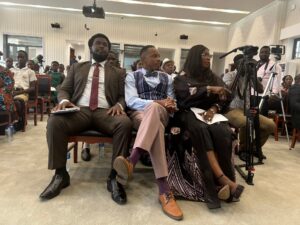

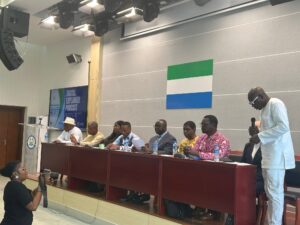
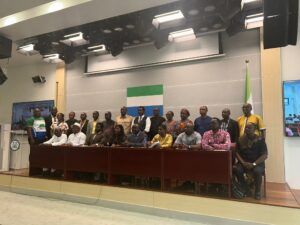
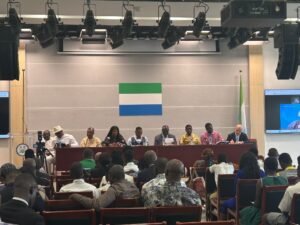
The panel discussion featured several high-level officials, including Dr. Emmanuel Gaima, Principal Adviser to the President and Head of the Public Sector Reform Unit; Abdel Aziz Bawoh, Deputy Minister of Information and Civic Education; Gilbert N’habay, Deputy Clerk of Parliament; Dr. Ibrahim Seaga Shaw, Commissioner for the Right to Access Information; and Jeremy Ben Simbo, Acting Executive Director of the Center for Accountability and Rule of Law. The session was moderated by Isata Mahoi, Minister of Gender and Children’s Affairs. Held as part of the annual global OGP Week observance, the event marked Sierra Leone’s ongoing commitment since joining the partnership in 2013 to deepen collaboration between the government and its citizens.