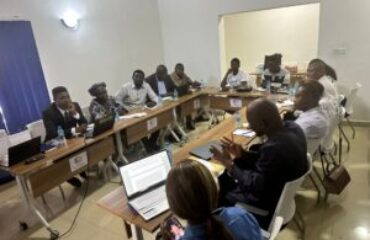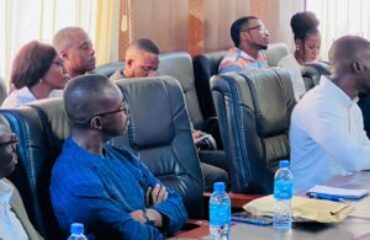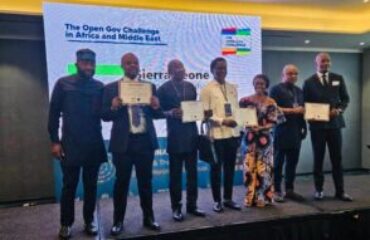
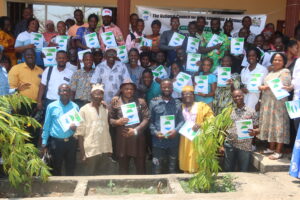
The National Council for Civic Education and Democracy (NaCCED), in collaboration with the Ministry of Finance, successfully conducted a nationwide rollout and regional engagement for the FY2026 Citizens’ Budget from March 27 to April 2, 2026. Under the theme “Enhancing Domestic Revenue Mobilization for Sustained Economic Stability and Improved Service Delivery,” the initiative aimed to bridge the information gap between government fiscal planning and the public by providing a simplified, accessible version of Sierra Leone’s national budget.
The process commenced with a national launch on Friday, March 27, at the Ministry of Finance headquarters in Freetown. During the event, Financial Secretary Mathew Dingie welcomed participants and outlined the ministry’s inclusive approach to budget drafting. He noted that despite external shocks from the war in the Middle East, the MoF is revising the budget to address revenue generation, aiming to increase domestic revenue to 20% of GDP by 2027. Key policy measures highlighted included a 35% increase in certain import duties aligned with ECOWAS tariffs, balanced by GST exemptions on Liquid Petroleum Gas (LPG), cooking stoves, and solar panels to support citizens. Chairman of NaCCED, Mr. Joseph Munda Bindi, emphasized that the Citizens’ Budget uses audiovisual animations and simplified text to explain technicalities, promoting transparency and accountability. Deputy Minister of Finance (1), Madam Kadiatu Alie, further urged stakeholders to explain revenue mobilization and inflation management in simple terms so citizens understand how resources relate to the Medium-Term National Development Plan.
Following the Freetown launch, the team conducted a regional tour to ensure inclusivity across the country. Engagements were held at the Kenema District Hall for the Eastern Region, the Bo District Hall for the Southern Region, the Bombali District Council Hall for the Northern Region, and finally the Port Loko District Council Hall for the North-West region, ensuring that residents from Kambia to Port Loko were fully informed and empowered to participate in national development. Throughout these sessions, Paramount Chief Representatives, Mayors’ representatives, and Chairpersons of District Councils attended, warmly welcoming the NaCCED Chairman and his team and expressing support for bringing fiscal information to the grassroots level.
In all sessions, Chairman Bindi explained that President Bio, following a recommendation from the Truth and Reconciliation Commission, established NaCCED to engage citizens and share information. He added that the Ministry of Finance, with support from partners, draws up a budget that guides the government’s development plan from now to 2030, focusing on the big five game changers. He reiterated that citizens contribute through taxes for developmental projects, and the aim of the Citizens’ Budget is for people to understand government activities, eliminate the notion that citizens do not know what the government does, and enable them not only to hold the government accountable but also to ask questions, support governance, and help educate others on paying taxes. He announced that a toll-free line would be established to gather public feedback and that empowered citizens should monitor projects to ensure their success. Chairman Bindi thanked participants for their attendance, noting that since President Bio’s election, effective civic education and attitudinal change have been necessary, which is why civics has been reintroduced in schools. He explained that a budget is a plan for generating and spending money, that a country cannot stand without one, and that the budget, once approved by Parliament, becomes law. Because the main budget is too bulky for many to read, the simplified Citizens’ Budget makes it easy for everyone to understand, with key objectives including domestic revenue collection for development, supporting central and local government, and enabling citizens to monitor activities and hold government accountable.
During the open discussions, participants raised several concerns, and officials responded. In Kenema, Abu Bakara Sheku Amara, representing the Ataya base community, praised the government for transparency and accountability but highlighted challenges in tax collection. He stated that some tax collectors do not report to offices or file GST, and he called on the government to implement an electronic payment system or for the National Revenue Authority to introduce such a mechanism. He also urged the public to always ask for receipts when paying for goods or services. In response, Chairman Bindi and the team affirmed that the government is working to increase the revenue base, enact stronger collection policies, and introduce innovation, including electronic payments, while calling on citizens to act as tax ambassadors and demand receipts.
Sahr Kawuja from Kono raised concerns about deplorable living conditions, lack of water and other facilities, abandoned projects across the country, and the incomplete Free Quality Education project in Kono, which was supposed to have been completed over three years ago. He recommended engagement with responsible parties and proper monitoring of projects. Chairman Bindi responded that citizens should identify incomplete projects in their communities to help the government and development partners, and that continued monitoring is a civic duty, though project completion remains the government’s responsibility.
Edward Kai, a non-state actor in Kenema, said that citizens cannot monitor government projects in a vacuum and requested all information about projects implemented by local councils in their communities to ensure better implementation. A member of the District Budget Oversight Committee in Kenema also stated that the budget is key to national development, though concerns about poor roads in Dama were raised; specifically, asking the government to construct the Moa road in Dama, given its importance to businesses that help develop the country. The Deputy Minister of Information and Civic Education responded that people should be loyal and patriotic to their country rather than to political parties, noting that many are not ready to work to protect the country as required by the Constitution, and that people must change their mindset that the wrong way is the right way. Regarding the road, the Chairman added that it is under construction.
Yatta Panda-Jusu said she believes the government is divided into local and central tiers and asked what mechanism exists for effective tax payment and whether the government has trained local councils on tax collection for community development. She also noted that under Free Quality Education, teachers’ salaries are not commensurate with their work, and she pleaded with the government to increase the education budget so teachers can teach effectively. Chairman Bindi responded that the government is focused on increasing the revenue base and bringing innovation to revenue collection, and he noted that the concerns about teacher salaries would be forwarded to relevant stakeholders.
Dassama, a non-state actor, observed that the 5% allocation to 22 local councils does not help them function effectively, as their projects are scattered across the country. He recommended increasing the local council percentage, employing more tax collectors, and addressing timber revenue, noting that timber has destroyed communities, and he wants to know how the government is benefiting from it. In response, Chairman Bindi pointed to the Port Loko District Council as an example of a council generating its own revenue by building shops to rent to business people, as well as working on other income-generating projects.
A member of the District Budget Oversight Committee from Kailahun recommended that NaCCED work with them to engage the media on the budget and the importance of tax payment. Sannoh appreciated NaCCED and the team but stated that there are many issues with budget deficiency and how people benefit from the budget; he recommended increasing taxes on items other than fuel, which would be a greater burden on the people, and also raised concerns about improving the justice sector. A non-state actor in Kenema raised concern about revenue loopholes at border areas with neighboring countries and asked the government to pay more attention to those areas, also commenting on the need for more technical institutions to support the workforce, including unemployed university graduates.
In Makeni, a youth representative contributed that integrity is key in tax collection, noting a vast difference between projected revenue and actual revenue collected, which leaves councils unable to operate. He added that CSOs and others have roles to play in the Feed Salone project. Chairman Bindi responded that government expenditure exceeds revenue, making monitoring essential, and that engagement allows citizens to participate in the budget process and hold government accountable. The Resident Minister’s representative added that people should value what is produced in Sierra Leone to increase revenue generation and promote local produce.
In Port Loko, Mr. Arthur Allieu, Chief Administrator of the Port Loko District Council, welcomed the team and explained that budget business is everybody’s business, requiring collective effort to strengthen community wellbeing and the democratic process. Chief Mohamed Mansaray praised the reintroduction of civics in schools, arguing that a country cannot develop if citizens do not understand their rights and responsibilities. Representing the Mayor, Santigie Kamara highlighted the struggle for councils to function without a strong own-source revenue base, called on all citizens to act as tax ambassadors, and noted that monies in the budget are not yet available but must be generated. Abdul Karim Bangura, Chairman of the District Budget Oversight Committee, encouraged people to disseminate budget messages and monitor budget implementation and development projects in their communities. NSA Regional Coordinator Mohamed Kamara noted that improved revenue generation will enable the government to solve problems and provide basic amenities, and that citizens’ responsibility is to monitor revenue utilization.
During the question and answer session in Port Loko, a civil society organization member acknowledged that the budget has a human face but asked what strategy is in place for its achievement. An NSA observed that councils often prefer collecting revenue rather than generating their own and recommended renovating and establishing housing facilities instead of renting new ones. It was also recommended that the government find an alternative to clean energy before increasing fuel prices. A non-state actor said she has not seen evidence of the Feed Salone project and that there is not enough investment in agriculture. Chairman Bindi responded that the strategy is to increase the revenue base, enact policies to increase revenue collection, and bring innovation to the process. He added that Feed Salone will only work when everyone works together as a team, and that the government should create an enabling environment to motivate people to engage in agriculture.
Yakorya from the Civil Society Consortium stated that the enforcement and implementation of government policies is a key problem and recommended that the animated video explaining the budget be left in each region for wider dissemination. She also recommended decentralizing agriculture to boost food production and suggested that councils build public toilets to generate more revenue. A comment on labor shortages at the community level led to a request for machinery to boost agriculture. Chairman Bindi responded that the video can be shared for proper dissemination, that more education on Feed Salone is needed, that people should follow the President’s efforts to promote farming, and that he will report to the Ministry of Agriculture on the need for machinery to address manpower shortages.
Foday Dada asked to prioritize domestic revenue generation in communities and called on CSOs, NSAs, and the District Budget Oversight Committee to talk about the importance of taxes, create room for citizen feedback on the Citizens’ Budget, and embark on farming. He also raised concerns about the local transport sector, noting that people do not respect the transport price list and that road conditions are poor. The Reverend reiterated concern about citizens monitoring tax collection, pointing to the massive gap between projected and actual revenue and stating that councils cannot operate effectively if tax collection lacks integrity; he called on the government to hold collectors accountable and on all Sierra Leoneans to change their attitude and practice what is within their capacity. An NSA asked that strategies be sustainable rather than political and short-lived.
Chairman Bindi, in his closing responses, reiterated that the toll-free line would be established for citizen feedback, that the animated video is available for dissemination, and that more education on Feed Salone is required. He urged locals to identify and monitor incomplete projects, emphasizing that while development is a government responsibility, oversight is a civic duty. He assured participants that all concerns raised would be forwarded to relevant stakeholders, including the Ministry of Agriculture for machinery, the Ministry of Finance for revenue policy, and the Ministry of Education for teacher salaries. He concluded by thanking all participants for their engagement and reaffirming that the Citizens’ Budget is a tool for open governance, accountability, and collective action toward sustained economic stability.