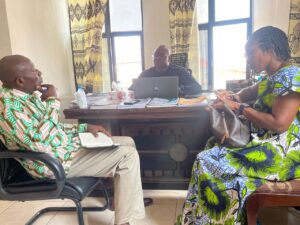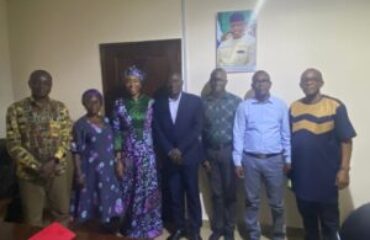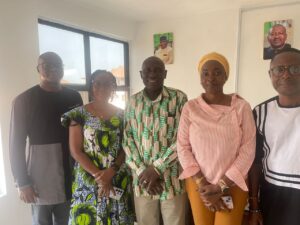
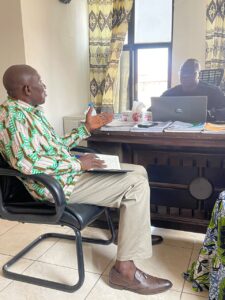
Chairman of the National Council for Civic Education and Democracy, Mr. Joseph Munda Bindi, has engaged the National Coordinator for the Sierra Leone Extractive Industries Transparency Initiative (SLEITI), Mr. Mohamed Baimba Koroma, at his Soldier Street office in Freetown. The visit aims to deliberate on Open Government Partnership (OGP) National Action Plan 5 (NAP)review recommendations and the outcome of Sierra Leone’s participation in the just concluded OGP Africa and Middle East Regional Meeting in Kenya .
The Chairman of NaCCED, during the engagement established that the work of NaCCED is elastic and extensive. It lays emphasis on understanding of government work and citizen’s rights and responsibilities as well.
He pointed out that the commitments in OGP NAP lies on the foundation of promoting transparency and accountability, bringing government close to the people, with support from Civil Society Organization to speak on their behalf. The Chairman further went on to say that the mid-term review showed that Sierra Leone is making significant progress in the implementation of its commitments and recognized as trail blazer within the OGP circle.
Mr. Bindi stated that the mining sector is a vast potential to tap into and that the people of this country have the right to know about the mining and land laws of the country as it is a win-win for the people and the country.
Referencing the NAP 5, which has a four-year implementation strategy, the Chairman said that SLEITI has done remarkably well. However, according to the Independent review mechanism report, it was disclosed that there is room for more improvement to expand on those milestones.
In his response, Mr. Mohamed Baimba Koroma, the National Coordinator of SLEITI said there is an urgent need for better understanding of the mining law of the country not leaving out the Land Rights Act as both laws complement each other for better implementation. He mentioned that SLEITI has been instrumental in promoting transparency and accountability in the mining sector.
Mr. Koroma pointed out that Beneficial Ownership is one key area where massive improvement is being made as the owners of many mining companies at times mask themselves behind shell companies but Beneficial Ownership requires certain data to ensure ownership behind the companies. Beneficial Ownership minimises tax evasion, money laundering and terrorist financing.
However, he mentioned that more needs to be done in the area of report submission by mining companies as there are often backlogs in reports. This affects the flow of data volume, compilation and the real-time publication of reports. He referenced the 2023 report that is only now being published in 2025.
With regards to strengthening Penalties, he also added that there is a penalty in the new SLEITI bill for companies that do not disclose beneficial ownership as currently they only name and shame the companies that fail to reveal the beneficial ownership data. He highlighted that strengthening SLEITI policy, revenue mobilization, and the environment to the multi-stakeholders’ group is needed to review the draft policy as well as Commitment on mainstreaming Systematic Disclosure on Extractive data, which can add to the level of transparency and accountability in the extractives sector.
The National Coordinator of SLEITI says they want to leverage on the OGP to work with the Right to Access Information Commission for the proactive disclosure of data by mining companies, specifically on export data in the area of volume and value of exports.
He pledged his commitment to continue to work with NaCCED and by extension Open Government Partnership for the benefit of the country and its people.