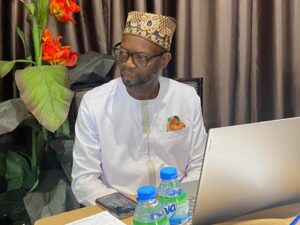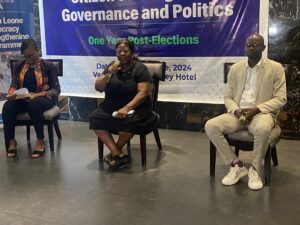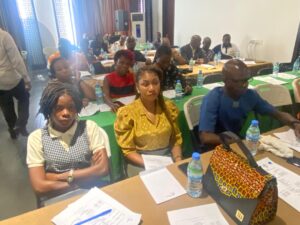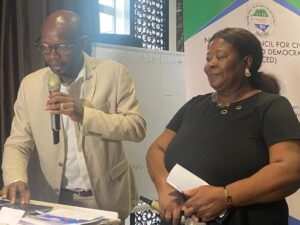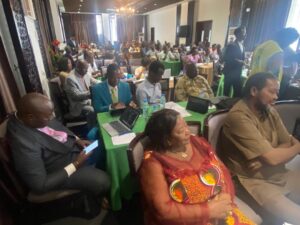
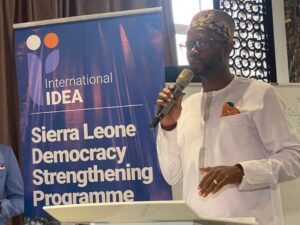
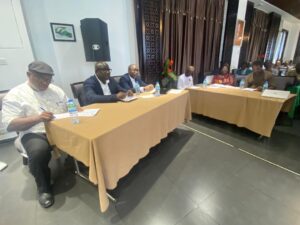
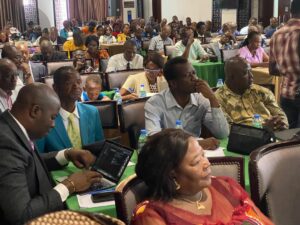
The National Council for Civic Education and Democracy, National Council for Democracy together with International IDEA, with funds from the European Union has ended a two-day session on Citizens Dialogue on Governance and politics marking one year since the June 24 2023 General Elections in Sierra Leone. The session was held at the Atlantic Lumley Hotel in Freetown.
The engagement drew over one hundred shareholders from different fields across the country to map the way forward on challenges that were encountered during Sierra Leone’s 2023 General elections and building better blocks for citizens participation in politics and governance.
Addressing the audience, the chairperson for the National Council for Democracy Madam Marian Samu emphasized that it is the duty of every Sierra Leonean to ensure participation and enjoy the democracy that every listening citizen in a democratic state should benefit from, not forgetting the role political parties should play in strengthening the country’s democracy.
Head of International IDEA Sierra Leone, Dr. Idriss Tarawallie said Sierra Leone is on a much more positive path in governance processes and inclusive dialogue. He went on to say that the sessions were purely on the interests of citizens which is based on research carried by the Global State of Democracy Report on which the foundation of principles of Representation, right to participation and the Rule of Law is active. He noted that citizens conversations on social cohesion is as a matter of what works and what is unique. Adding that one year after elections the critical question citizens should ask themselves is: How are we contributing to governance process and how can we ensure that citizens processes and systems works at the heart of governance and politics.
Representative European Union Julius Foday said engagement in national discourse will enhance equitable distribution of resources and that through EU’s engagement critical reforms through have been made through the Parliament of Sierra Leone, PPRC, APPA, and CSOs that were definitely needed and that institutions ought to be honest about the discourse of taking ownership and finding ways to factor in the opinion of citizens who are not opportune to be part of the process.
Democratic tendencies, Mr. Julius Foday went on to say is at the heart of global good governance tendencies and civic responsibility especially in the discourse of human rights.
In his overview, Chairperson of the National Council for Civic Education and Democracy, Ibrahim Kalilu Totangi s said the significance of the 1-year post elections on citizens should be about a thorough look into at the state of democracy and thinking the way forward.
Pointing out the some of the successes during the 2023 General Elections, having worked with the Electoral Commission Sierra Leone statistics are there to show that violence before, during and after elections were minimal. Kalilu said statistics were recorded that 80% of citizens were able to carry out their voting rights.
On the status of the Electoral Review Systems, the Chairperson NaCCED said it was dominated by political parties rather than citizens. Therefore, he called for a more citizen-driven approach to evaluate and improve the electoral system for better representation.
He continued to lay emphasis on the importance of civics. Mr. Totangi said there is need to deepen the conversation on “why we are the way we are and that the business of government is to secure the needs of its people “
In his keynote address, the Chief Electoral Commissioner, Mohamed Kenewui Konneh on a conversation with a prominent civil society advocate in West Africa, highlighting the often-overlooked role of Electoral Commissions’ post-elections referencing hat elections are the cornerstone of democracy and the primary means by which citizens engage directly in political processes, stressing the necessity for inclusivity, ensuring that all eligible citizens, including women, men, and persons with disabilities, can participate in the electoral process without barriers.
Mohamed Kenewui added that modern trend towards inclusivity, aimed at eliminating discrimination and fostering participation in all aspects of democracy and governance. He detailed the ECSL’s efforts to promote inclusive electoral processes, citing their strategic plan for 2024, which focuses on strengthening electoral processes for maximum performance.
The Chairman of ECSL Mohammed Konnewi Konneh said of the many reforms made by the ECSL, the electoral inclusion department, requirement of female and persons with disabilities, developing policies that guides their operation, reviewing the public elections act as it was recommended are steps that have been taken so far.
The Chairman of ECSL said the political willingness of political parties for vacant positions discouraged political nominations in certain areas that need female representation in politics. Adding that the Electoral Management Review Systems created a balance for the effectiveness of ECSL’s conflict prevention team, better coordination of political parties and most importantly creating an environment that will assist free, fair and credible elections.
The Chief Electoral Commissioner emphasized the ECSL’s commitment to transparency and collaboration with stakeholders, including political parties, civil society organizations, and the media. He highlighted the importance of accessible electoral information and extensive consultations with all relevant parties.
During the session, Dr Charles Silver, Lecturer at Fourah Bay College underscored that Democracy is the acceptance of introducing new ways of addressing social and economic conditions and civic education is the first step to doing the right thing.
From the Civil Society perspective, Andrew Lavalie laid premium on the need for more room to be given by international and local elections observers and the need for better redistribution of resources.
Marcell Samba, Chairperson Campaign for Good Governance said as Sierra Leoneans we should accept that is a process and not a destination hence experts also should be provided with the need free hand to do their work.
The ceremony was followed by panel discussions with the theme Citizen’s Participation in Consolidating Democracy wherein nine recommendations were put forward for adoption in a communiqué aimed at strengthening Sierra Leone’s democracy through inclusive participation.