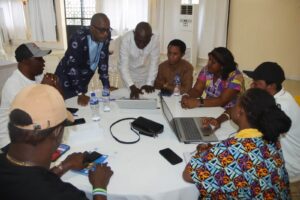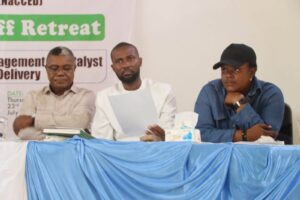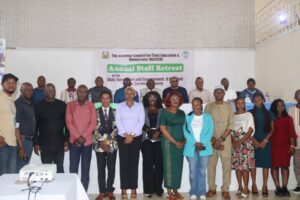
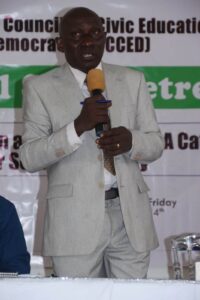
The National Council for Civic Education and Democracy (NaCCED) has successfully concluded its highly anticipated 2026 Annual Staff Retreat at the Galliness Paradise Hotel in Bo City on July 23rd and 24th. The intensive two-day strategic engagement brought together key stakeholders, government officials, local authorities, Civil Society Organizations and staff members to critically assess institutional progress and chart a robust operational roadmap under the theme: “Civic Education and Engagement: A Catalyst for Service Delivery.”
In his opening address and overview of the retreat at the official opening ceremony, NaCCED Chairman Mr. Joseph Munda Bindi underscored the profound significance of the retreat, framing it as a pivotal moment for the institution to recalibrate its systems.
“In order to execute a truly nationwide civic engagement initiative that resonates with the diverse population of Sierra Leone, we must first understand what resonates with our people at the grassroots level,” Chairman Bindi emphasized. He proudly highlighted the landmark achievement of integrating civic education as a formal subject in all government and government-assisted schools across all sixteen districts, a joint success with the Ministry of Basic and Senior Secondary Education (MBSSE).
Addressing the gathering on behalf of the
Chairperson of the Parliamentary Committee on Information and Civic Education, Hon. Rugiatu Rosy Kanu, the Member of Parliament representing Bonthe District, Hon. Jibrila Sur Moijueh, delivered a powerful message underscoring that no government can achieve lasting success without an informed population.“Civic education transforms citizens from passive recipients into active partners in governance,” Hon. Moijueh asserted. “When our people understand their rights and responsibilities, hold public institutions accountable, and engage in community development, service delivery becomes more effective, transparent, and inclusive.”
The lawmaker noted that the retreat’s agenda aligns closely with Sierra Leone’s National Development Plan (2024–2030) and UNESCO’s Global Citizenship Education framework for 2030. While commending the collaborative strides made by NaCCED staff, Parliament, civil society, and the media, Hon. Moijueh issued a firm call for intensified field operations, urging that civic awareness campaigns must penetrate deep rural communities and meaningfully include youth, women, and persons with disabilities.
Echoing the call for public participation, the Chief Education Officer of the MBSSE, Mr. Edward Kpakra, challenged the audience on the limits of independent state action. “When citizens transition from being mere observers to becoming genuine partners in the development process, they evolve into responsible citizens for life,” Mr. Kpakra remarked.
Adding a structural perspective, the Principal Executive Adviser to the President and Head of the Public Sector Reform Unit, Dr. Emmanuel Gaima, called for a wholesale national consciousness regarding civic responsibilities. He urged NaCCED staff to target values, behaviors, and positive attitudes as the bedrock of civic consciousness while forming strategic partnerships across state institutions to rebrand Sierra Leone.
The Deputy Minister of Information and Civic Education, Mr. Abdel Aziz Bawoh, in his keynote address reiterated his ministry’s unwavering commitment to overseeing and supporting NaCCED. Drawing a sobering reference to the Truth and Reconciliation Commission (TRC) report, Mr. Bawoh reminded the gathering that civic ignorance, misinformation, and disinformation were root causes of past conflict. He stressed the urgent need to expand citizen engagement to counter modern technological threats, including the rapid proliferation of Artificial Intelligence.
From an administrative angle, the Senior Permanent Secretary of the Ministry of Information and Civic Education, Andrew Kamara, noted that civic education and citizen engagement have become more important than ever in strengthening democratic governance and improving service delivery.He stated that NaCCED occupies a strategic position in fostering an informed, engaged, and responsible citizenry whilst emphasizing that the work of NaCCED is central to the realization of the Government’s objectives.
Kamara described the retreat theme, “Civic Education and Engagement: A Catalyst for Service Delivery,” as both timely and appropriate, pointing out that effective service delivery is a shared responsibility requiring informed citizens who understand their rights.
Acknowledging that significant progress has been witnessed in civic engagement initiatives across the country over the past few years, he stressed the need to continue adapting to emerging challenges and opportunities. In the area of capacity building, he urged staff of NaCCED to develop practical strategies to strengthen institutional capacity and enhance the impact of civic education programs. He reaffirmed the Ministry’s full commitment to supporting NaCCED in the discharge of its mandate, whilist calling on participants to think boldly about leveraging innovation and strengthening community engagement.
Other stakeholders who made valuable contributions at the opening session include the Resident Minister of Southern Region, Mr. John Abu, Bo District Council Chairman, Mr. Victor Kosseh Hindowa, representative Hawa Sia Taylor of the Regent Chief of Kakua Chiefdom and madam Evelyn Turay who represented theWomen’s Forum Sierra Leone Bo District Coordinator from the CSO network.
The Resident Minister, Chief John Abu, underscored that effective service delivery remains a core mandate of his office, emphasizing a dual responsibility: not only ensuring that constituents tangibly benefit from government programs but also actively equipping them to contribute meaningfully to the locality’s developmental agenda. “Our people view us as a pillar of support in matters of governance,” he stated. “However, beyond providing that support, civic education is critical—it fosters the understanding that development is a shared effort and ensures our communities are well-informed participants in the process.”
Addressing the growing influence of technology, the Minister cautioned that while artificial intelligence offers numerous advantages, its darker applications—particularly the creation of fabricated images, fake videos, and misleading content—pose a significant threat to public trust and social cohesion. He noted that citizens in rural villages, who may lack the digital literacy to discern fact from fiction, are especially vulnerable to such manipulations. As a result, he called on all citizens to practice responsible citizenship: to verify information before sharing, rely on official channels for news, and collectively guard against the spread of disinformation. Only by doing so, he concluded, can communities safeguard their democratic processes and maintain the integrity of the development dialogue
The two-day brainstorming sessions produced a roadmap in the following major outcomes such as a comprehensive institutional diagnostic report on NaCCED produced, a review of a well-structured organogram and human resource management manual developed, review of strategic Communication Framework to strategically place NaCCED at the center of Civic Education the Strategic Plan was reviewed and properly aligned with the Midterm National Development Plan (MTNDP 2024-2030)
It was also finalized that a framework for the establishment and operationalization of Civic Education Hub in schools will be developed.A Strategic Pillars for nationwide civic education and NaCCED Flagship programmes developed together with a proposal and roadmap for amendment of the NaCCED Act 2022 formulated
The retreat concluded by producing resolutions which is referred to as “Bo Galiness Declaration”. The comprehensive frameworks developed during these sessions will serve as the operational foundation for NaCCED in the coming years, ensuring the institution remains at the forefront of democratic renewal and public accountability in Sierra Leone.