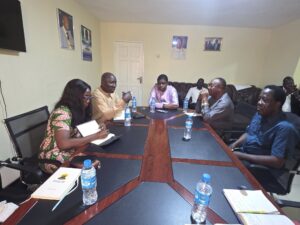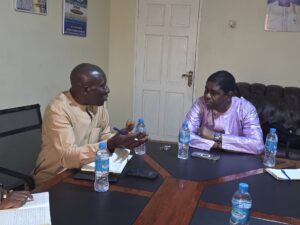
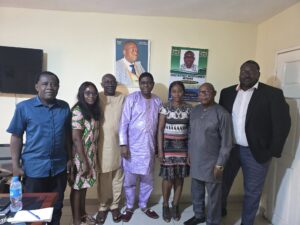
Freetown – The Chairman of the National Council for Civic Education and Democracy (NaCCED), Mr. Joseph Munda Bindi during a courtesy visit has held strategic discussions with the Right to Access Information Commission (RAIC) to strengthen Sierra Leone’s implementation of its Open Government Partnership (OGP) commitments under National Action Plan 5 (NAP 5).
Giving the purpose of the visit, OGP Coordinator, Mrs. Hannah Hamida Jimmy, explained that the engagement is as a result of a recent assessment by the OGP Independent Review Mechanism (IRM), which evaluated Sierra Leone’s progress in promoting transparency, accountability, and citizen participation. The report, received shortly after the NaCCED Chairman assumed office, highlighted achievements and areas needing improvement in NAP 5 implementation.
Describing the meeting as a significant opportunity, the NaCCED Chairman emphasized his commitment to fostering partnerships with key institutions like RAIC. “Since assuming office, I have been eager to engage with our partners to ensure we work collectively for the nation’s progress,” he said. “Collaboration between NaCCED and RAIC is essential to achieving our shared goals.”
Chairman Bindi credited President Julius Maada Bio for reintroducing civic education, which had lapsed in previous years. He linked the absence of civic education to rising lawlessness, stressing that it plays a vital role in nurturing patriotism, the rule of law, and social harmony.
“Civic education instills love for country and teaches citizens how to coexist peacefully,” he noted. “Without it, even the best development plans may fail. An informed citizenry is the backbone of national progress.”
The Chairman clarified that NaCCED does not duplicate RAIC’s work but instead focuses on educating the public about RAIC’s mandate and the benefits of access to information. “Our role is to amplify RAIC’s message and engage citizens on their right to information,” he explained.
To maximize impact, NaCCED has streamlined its operations, aligning with the government’s Big Five Changer agenda and prioritizing engagements with MDAs that support these strategic goals.
The Chairman reiterated that OGP’s core principles which include transparency, accountability, and inclusion are critical to Sierra Leone’s governance framework. While the country has made strides in implementing the Right to Access Information Act, the IRM report identified gaps in NAP 5’s alignment with OGP standards.
“Information is available but often locked away,” the Chairman observed. “Government must proactively disclose information to build public trust and ensure accountability.”
The report noted that some NAP 5 milestones lack clear mechanisms for citizen involvement and legal backing, limiting their effectiveness.
The NaCCED Chairman reaffirmed his institution’s commitment to supporting RAIC in addressing the IRM’s recommendations. “We will work together to enhance public engagement, strengthen legal frameworks, and ensure Sierra Leone meets its OGP obligations,” he said.
The meeting underscored the importance of inter-institutional collaboration in advancing open governance and civic empowerment in Sierra Leone.
RAIC Executive Secretary Hon. Mustapha Brima commended NaCCED’s initiative to engage with Ministries, Departments and Agencies (MDAs), stating this partnership would “reinforce collaboration, collective thinking and mobilization” in their operations. He reaffirmed RAIC’s commitment to working closely with both NaCCED and the Open Government Partnership (OGP).
Dr. Ibrahim Seaga Shaw, Chairman of RAIC, highlighted the natural alignment between their institutions’ work. Access to information is fundamental to civic education,” Dr. Shaw emphasized while noting that it enables citizens to understand government activities and participate meaningfully in society.
The Chairman revealed ambitious plans to institutionalize transparency, including developing a proposal to enhance public sector accountability using RAIC laws and the Civil Service Code, introducing access to information concepts into school curricula and also encouraging NaCCED to implement proactive information disclosure on its website
Dr. Shaw stressed these initiatives would address challenges identified in the Truth and Reconciliation Commission report while fostering openness. “We cannot achieve true transparency without strong partnerships,” he noted, identifying OGP as a crucial ally in these efforts.
The meeting concluded with both institutions committing to regular collaboration and information sharing. This partnership marks a significant advancement in Sierra Leone’s open governance agenda, with potential to transform citizen-government engagement through improved access to information and civic education.